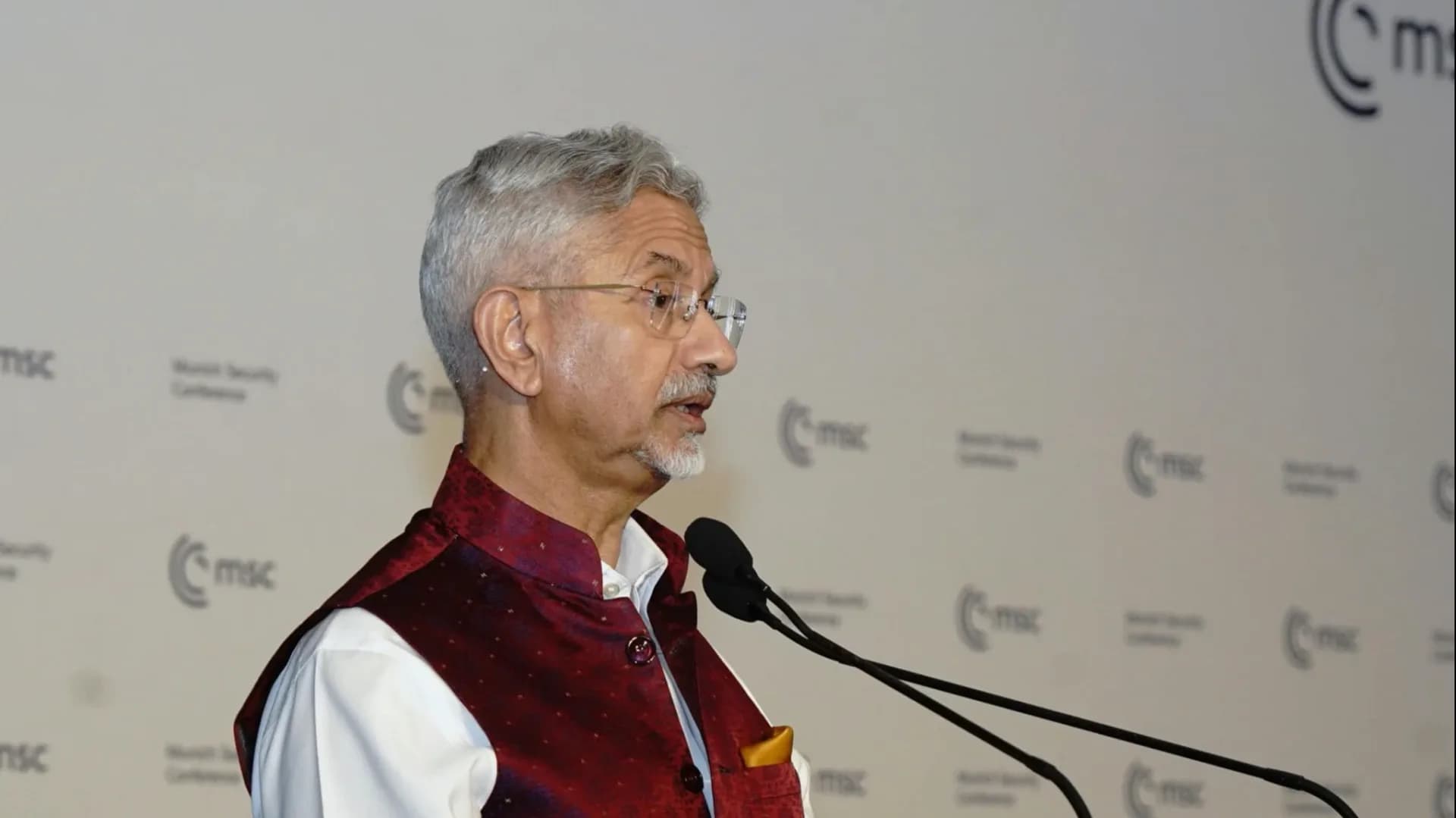
External Affairs Minister S Jaishankar said on Sunday that India had, in recent months, become "a little bit more involved beyond advocacy".
Speaking at the Munich Leaders' Meeting in New Delhi, he said India was talking to both sides and was "trying to be helpful", initially on the safety of shipping in the Black Sea and later on grain and energy exports and "non-attack possibilities". The comments mark a shift in how India is describing its role in the conflict. Since Russia launched its full-scale invasion of Ukraine in February 2022, New Delhi has consistently argued that the war cannot be resolved on the battlefield and that dialogue and diplomacy are the only way forward.
India has maintained relations with both Moscow and Kyiv throughout the conflict. It has continued to buy Russian oil and has not joined Western sanctions against Russia, while also maintaining diplomatic engagement with Ukraine.
Jaishankar's comments came after Ukraine's Foreign Minister Andrii Sybiha said on Friday that Kyiv was examining four proposals aimed at reducing the fighting, from India, the United States, Türkiye and Egypt. "The most comprehensive is India's proposal. For the first time, India has signalled its willingness to play a role," Sybiha said, according to Ukrainian media.
On 31 August, Prime Minister Narendra Modi told Russian President Vladimir Putin, on the sidelines of the Shanghai Cooperation Organisation summit in Bishkek, that the world must move "from endless war to the end of war" and towards a cessation of hostilities.
"This is crucial for all of humanity,"
he said.
Three days later, on 3 September, Jaishankar made the first standalone visit by an Indian external affairs minister to Ukraine. In Kyiv, he met President Volodymyr Zelenskyy and Sybiha, offered India's help in ending the war and raised concerns over the safety of commercial shipping and seafarers.
Jaishankar has also held talks in Moscow, including meetings with Putin and Russian Foreign Minister Sergey Lavrov during his visit in the last week of August.
For India, the issue is also directly linked to the safety of its citizens and commercial interests. In July, Indian crew members were killed in attacks on commercial vessels in the Black Sea. Four Indians died when the Golden Leo was struck after leaving Odesa on 19 July, while an Indian officer was killed aboard the MV Omorfi on 18 July.
New Delhi summoned diplomats from both sides and called for the safety of navigation. Neither Moscow nor Kyiv has publicly confirmed the substance of India's talks or the details of its proposal. India is an unusual interlocutor. It maintains close ties with Russia while also engaging Ukraine and retaining relations with the United States and European countries.
For more than four years, New Delhi has largely called on Moscow and Kyiv to find a negotiated solution. Its latest statements suggest that India now wants to do more than call for talks.