
Each of the four hijacked planes had departed from the East Coast bound for California, meaning they were heavily fueled for the long journey. American Airlines Flight 11 took off from Boston for Los Angeles with 92 people on board—the plane was hijacked at around 8:14 a.m. Eastern Time, and at 8:46 a.m. it crashed into the north facade of the World Trade Center's North Tower, between the 93rd and 99th floors.
Four planes, one morning
American Airlines Flight 77, which departed from Washington Dulles International Airport with 64 people on board, was hijacked over southern Ohio; the plane struck the western facade of the Pentagon at 9:37 a.m. at a speed of over 500 mph (800 km/h), piercing three of the building's five concentric rings.
The fourth plane, United Airlines Flight 93 from Newark to San Francisco, took off roughly 42 minutes late at around 8:42 a.m. due to a delay; the plane was hijacked over northern Ohio at 9:28 a.m., by which time passengers and crew had learned via mobile and cabin phones about the attacks on the World Trade Center.
When the plane was hijacked, several passengers called loved ones or customer service lines to report that they were planning an organized resistance.
The most famous of these calls was made by Todd Beamer, who stated that the pilot and co-pilot were likely injured or dead, and that he and other passengers—including Tom Burnett, Mark Bingham, and Jeremy Glick—were attempting to retake control of the aircraft.
The cockpit voice recorder captured sounds of a struggle shortly before 10:00 a.m.; amid maneuvers by the hijacker-pilot, the plane then crashed uncontrollably into the ground at 10:03 a.m. in an empty field near Shanksville, Pennsylvania. All 40 people on board were killed. According to the 9/11 Commission Report, the aircraft's likely target was the United States Capitol in Washington, though this was never fully proven.
The towers collapse
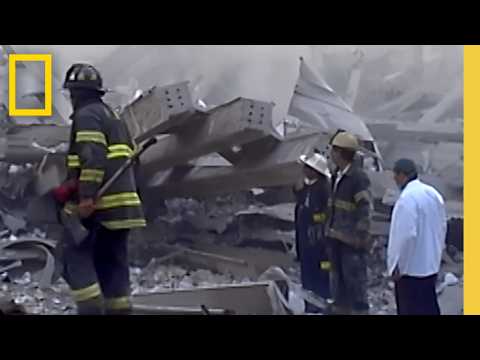
The two towers of the World Trade Center did not collapse simultaneously. The South Tower—despite being hit second—collapsed at 9:59 a.m., just 56 minutes after impact, because the strike by United Flight 175 caused disproportionately greater structural damage. The North Tower collapsed at 10:28 a.m., 1 hour and 42 minutes after it was hit. Engineering analyses indicate that in both cases, the impacts stripped the fireproofing insulation from the steel framework, and the subsequent jet fuel-fueled fires weakened the load-bearing columns to the point where they could no longer support the building's weight.
The victims
According to official figures from the National September 11 Memorial & Museum, 2,977 people died as a direct result of the attacks—a figure that excludes the 19 hijackers.
Among the first responders, 343 New York City firefighters lost their lives that day—the largest single-day loss of life in the history of the fire service—along with 37 Port Authority police officers and 23 New York City police officers.
Claiming lives decades later
One of the lesser-known yet steadily worsening aftermaths of the attacks is the health toll of the toxic dust generated by the collapsing buildings.
Within the New York City Fire Department alone, 409 firefighters have died from 9/11-related cancers and other illnesses since the attacks—a number that has now surpassed the number of firefighters who died on the day of the attacks.
Perpetrators and consequences
The attacks were carried out by al-Qaeda under the direction and approval of Osama bin Laden, who operated the network under the protection of the Taliban regime in Afghanistan—he was killed by US special forces on May 2, 2011, at a hideout in Pakistan.
Khalid Sheikh Mohammed, identified as the principal mastermind of the attacks—a Pakistani national raised in Kuwait who earned an engineering degree in the United States—had already pitched a similar, even larger-scale plot to bin Laden in 1996, according to the 9/11 Commission; he also oversaw the selection and training of the pilot-hijackers, though he did not board any of the planes himself. He was captured in Pakistan on March 1, 2003.
On the day of the attacks, at approximately 9:45 a.m., the Federal Aviation Administration ordered the complete shutdown of US airspace—an unprecedented measure—diverting an estimated 4,050 aircraft then in the air to the nearest available airports. President George W. Bush declared the "War on Terror," and on October 7, the military operation in Afghanistan was launched against al-Qaeda and the Taliban regime protecting them. The ensuing two-decade war was a direct consequence of the September 11 attacks.
Commemorating the 25th anniversary
For the 25th anniversary, a ceremony beginning at 8:30 a.m. at the memorial plaza will feature family members personally reading aloud the names of the 2,983 victims. In the evening, the "Tribute in Light" art installation symbolizing the twin towers will illuminate the Lower Manhattan skyline.